
Estimated Read Time: 5 minutes
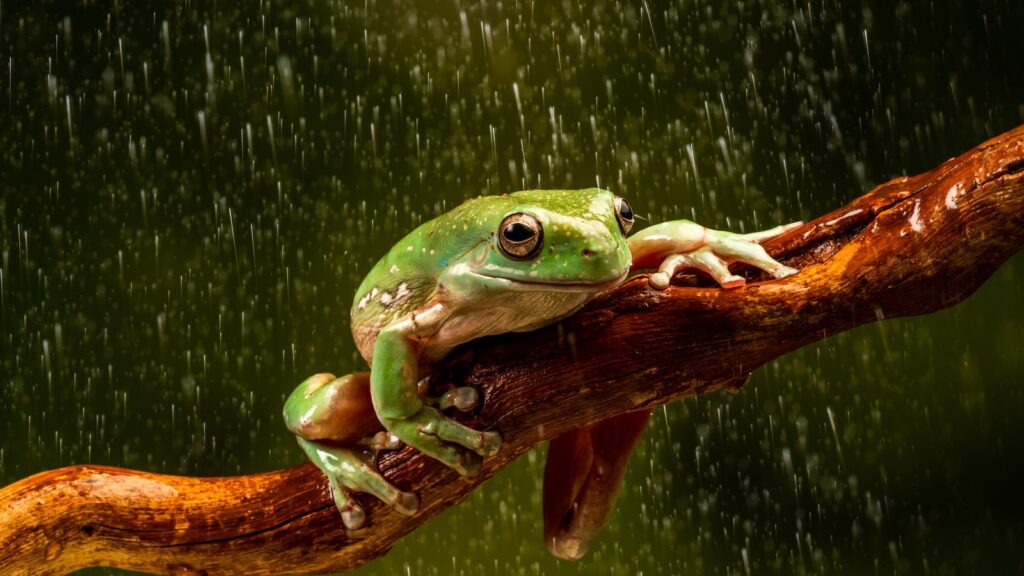
Did you know a White’s tree frog can live up to 23 years under proper care?
The gentle White’s tree frog is a popular pet that doesn’t need much space, is generally easy to care for, and is a laid-back companion for all ages.
Learn about this unique amphibian and get some advice to give your pet a happy, healthy life!
White’s Tree Frog’s Natural Habitat
The white’s tree frog is native to humid regions of Australia and southern New Guinea. As their name suggests, they’re most often found in trees.
That said, they aren’t great swimmers, so to find water, they look in cup-shaped leaves and tree crevices that collect rainwater.
Their bodies are adaptable, so you may also find them in drier suburban areas. To survive in these areas, their bodies emit a slimy substance called caerviein, which acts as a moist cocoon to fight against dehydration.
Temperament and Behavior

White’s tree frogs are arboreal and nocturnal, so they’ll rest on tree branches or inside trunk crevices during the day, then venture to the ground in the evening.
They’re very docile frogs, but if threatened, they will let out an ear-piercing scream to deter predators.
And they’re not poisonous, either. In fact, substances extracted from their skin have medical uses for humans, like fighting bacteria, lowering blood pressure, and treating cold sores.
Requirements for a White’s Tree Frog Enclosure
Enclosure Size
White’s tree frogs can grow to about 2 to 4 inches from snout to vent. They may be small, but they’re arboreal, so their enclosure should provide climbing space.
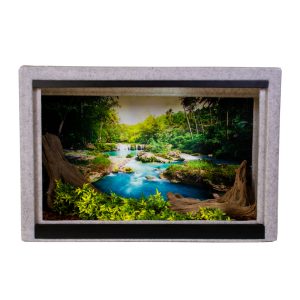
An adult white’s tree frog lives very comfortably in our Model 111 Vision Cage (20-gallon volume). If you plan to house multiple White’s Tree frogs, consider a larger enclosure, like the Model 215 (30-gallon volume).
-
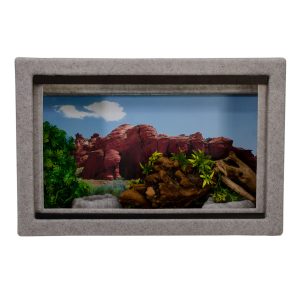 Model 111 Cage$259.00
 -
Model 215 Cage$299.00
Temperature
A white’s tree frog’s natural habitat is generally hot and humid.
Create a temperature gradient with a general air temperature throughout the enclosure and a hotter side for basking.
- General Air Temperature: 74°-76°
- Basking Spot Temperature: 82°-84°
- Nighttime Temperature: 65°-72°
To achieve an ambient nighttime temperature, turn off the overhead heat sources and use an under-the-tank heater.
Vision Cages have built-in ventilation, and you can easily control temperature with a 1000-watt thermostat and probe.
Humidity
Maintain a humidity level between 70% and 90%. These frogs require a moist environment to survive, so monitor environmental moisture levels regularly.
Is the humidity dropping below 70%? Increase it by misting with a spray bottle twice daily (once in the morning and once in the evening). We also offer an automatic mister to make this task hassle-free!
Substrate and Bedding
While they spend most of their time in trees, substrates play a significant role in maintaining humidity and temperature.
We offer a mold-resistant, bark-based substrate designed for humidity-loving animals that retains and slowly releases moisture into the environment.
Everyday household items can be used as substrate, such as paper towels or newspapers. They’re inexpensive and absorb moisture, but paper doesn’t mimic their habitat, and you’ll have to clean and replace it more often.
Accessories
Include tree branches for climbing and elevated surfaces for hiding.
Include at least one form of a hide on the ground level. In their habitats, they often lie in hollow logs or tree trunks, so look for a hide that reflects this.
Water features, like misters and water bowls, are also recommended for consistent hydration. We have a large selection of water bowls to help reach the optimal moisture.
Your Frog’s New Home
Vision Cages are available in 16 sizes, catering to reptiles of all shapes and sizes!